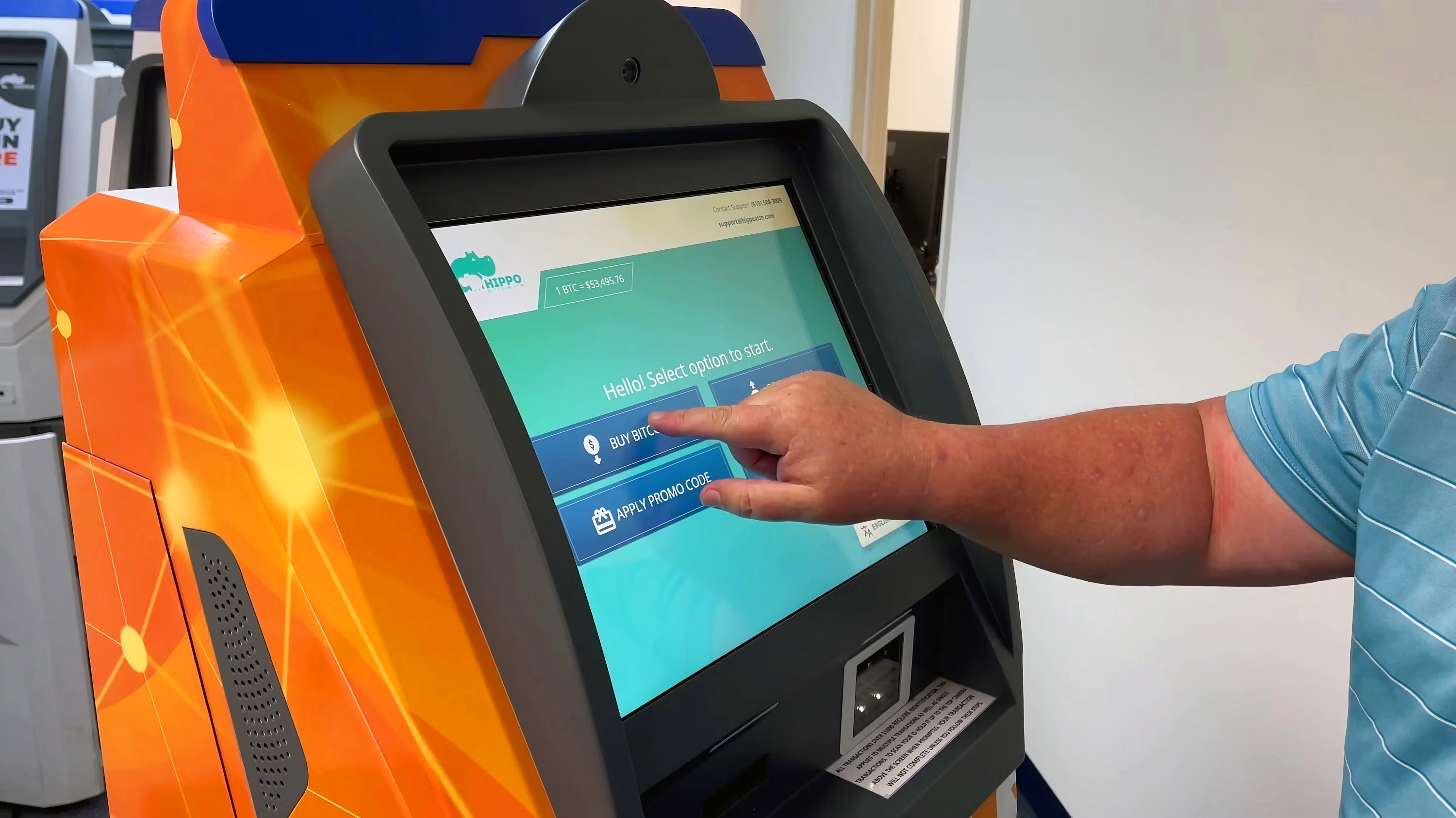
What Jacksonville machines actually charge
Every conversation about kiosk fees goes wrong in the same place: people quote the number on the screen. That number is roughly half the cost.
A Florida kiosk earns money in two layers.
- The stated fee. A percentage shown before you confirm — typically 8% to 14%. Operators compete on this number because it is the visible one.
- The exchange-rate markup. The machine quotes a bitcoin price 3% to 8% worse than the real market price. Nowhere disclosed as a fee, and the reason two machines advertising identical percentages can cost you different amounts.
Together those produce 11% to 19% all-in in Jacksonville. The same purchase on a licensed exchange order book costs about $2 to $6 per $1,000.
Compare the machine's price to the real price
Before confirming, open any price site or exchange app and look at the current bitcoin price. Then look at the rate the machine is quoting. The gap is the markup — the half of the fee nobody tells you about.
Jacksonville has the widest internal kiosk price range of any Florida city we have modelled, and the reason is simply size. At roughly 875 square miles the city contains several genuinely different economies, and the price of the same $500 of bitcoin varies by eight percentage points depending on which of them you are standing in.
Beach Boulevard and the Southside corridors carry dense retail and several competing operators, producing 11% to 15% all-in. The Westside along Normandy Boulevard has thinner bank branch coverage and a more cash-dependent customer base, producing 15% to 19%. That is roughly $40 difference on a $500 purchase for a twenty-minute drive.
This page maps the corridors. Our full Jacksonville guide covers the wider market, including the city's banking and fintech employment and the military considerations around NAS Jacksonville and Mayport.
Corridor by corridor
Kiosk pricing in Jacksonville is a function of local competition and customer type, not local cost. Machines cluster where cash usage is highest and banking access thinnest — and they price accordingly.
| Corridor | Density | All-in cost |
|---|---|---|
| Beach Boulevard & Southside | High | 11–15% |
| Atlantic Boulevard & Arlington | High | 12–16% |
| Baymeadows & UNF corridor | Moderate | 12–16% |
| Downtown & the Southbank | Low | 13–17% |
| San Marco, Riverside & Avondale | Very low | n/a |
| NAS Jacksonville & Mayport corridors | Moderate | 13–18% |
| Normandy Boulevard & the Westside | Very high | 15–19% |
| Jacksonville Beach, Neptune & Atlantic Beach | Moderate | 15–19% |
Beach Boulevard & Southside
Long east–west commercial artery with dense retail and several competing operators. The best-priced corridor in the city and worth driving to from almost anywhere in Duval County.
Atlantic Boulevard & Arlington
Established residential and retail east of the river. Solid coverage plus supermarket voucher machines. Mid-range and generally reliable.
Baymeadows & UNF corridor
University of North Florida plus a large corporate and residential corridor. Machines serving student and commuter traffic at mid-range fees.
Downtown & the Southbank
The banking and insurance core, with major operations centres for national financial institutions. Very few machines — this is a card-and-app population — but the highest concentration of fintech employment in North Florida.
San Marco, Riverside & Avondale
Walkable, affluent historic neighbourhoods. Almost no kiosk demand; a number of independent merchants have experimented with crypto payments instead.
NAS Jacksonville & Mayport corridors
Two major naval installations with tens of thousands of active-duty personnel and dependants. Machines in surrounding stores, alongside the concentration of high-cost financial products that gathers outside every large base.
Normandy Boulevard & the Westside
Older commercial corridor with a heavily cash-based customer base and historically thin bank branch coverage. The city's highest density and highest fees, priced against check-cashing rather than exchanges.
Jacksonville Beach, Neptune & Atlantic Beach
Visitor-priced machines on the beaches. Drive inland to the Southside before buying.
Our own modelling from published operator schedules plus observed exchange-rate markups. Individual machines vary considerably — always read the on-screen quote before confirming.
What is specific to Jacksonville
Two Jacksonville-specific points are worth more than the fee table.
The geography arbitrage is unusually large. In most Florida cities, driving to a cheaper machine saves two or three percentage points. In Jacksonville it saves four to eight, because the city is big enough to contain genuinely different markets. If you buy with cash regularly, learning that Beach Boulevard beats Normandy is worth real money over a year.
Coinme has the widest raw location count in the city — through Coinstar machines inside grocery chains plus Coinme Cash retail partners. It is important to understand that this is a voucher product, not an ATM: you pay cash, receive a printed code, and redeem it in the Coinme app, which requires a verified account. Coinme's own documentation describes an all-in cash exchange fee of roughly 15% to 18% depending on location, plus a 4% transaction fee. Many Jacksonville users do not realise it is a different product from the coin-counting machine beside it. See our Coinme guide.
Which operators still work
The Florida kiosk network contracted sharply in 2026. Bitcoin Depot — for years the largest operator in North America — filed Chapter 11 in the US Bankruptcy Court for the Southern District of Texas on 18 May 2026 and took its entire network of roughly 9,700 machines offline, about 156 of them in Florida.
The stickers are still on the walls
Convenience stores across Florida still display Bitcoin Depot branding, and those machines are
dead. Do not insert cash to find out. Check the operator's own locator rather than a
third-party aggregator before you travel — aggregator data lags reality by weeks.
There is a second lesson. Customers who had left balances in wallets the operator
controlled became unsecured creditors in a bankruptcy. Customers who had sent crypto to a wallet
whose recovery phrase they held themselves lost nothing. If a machine offers to "create a wallet
for you", decline — set up your own first.
CoinFlip
The largest surviving network in Florida at roughly 270 machines statewide. Published buy fees commonly quoted in the 4.99%–21.90% band depending on machine and amount. Also runs an OTC desk for larger tickets.
Byte Federal Florida HQ
Headquartered in Venice, Florida — the only large national operator based in the state — with 110-plus Florida sites. Disclosed a breach affecting approximately 58,000 customers in December 2024.
Athena Bitcoin
Headquartered at 1 SE 3rd Avenue in downtown Miami. Machines across 29 states and five Latin American countries, plus its own OTC desk for private clients.
Coinme at Coinstar
The widest raw location count in Florida — but a voucher product, not an ATM. Coinme's documentation describes an all-in cash exchange fee of roughly 15% to 18% plus a 4% transaction fee.
RockItCoin
A smaller Florida presence, roughly 30 machines statewide, with live phone support during a purchase — useful for a first-time buyer, though the fee still applies.
Bitcoin Depot Shut down
Chapter 11 filed 18 May 2026; the entire ~9,700-machine network offline, including about 156 in Florida. If a machine still carries this branding, walk away.
Limits, ID and the 2027 caps
Today, limits and identity requirements vary by operator and verification tier. Small purchases have historically been possible with only a phone number; larger tiers require a government ID and a selfie.
From 1 January 2027, Florida's Virtual Currency Kiosk Act changes this statewide.
The caps aggregate across transactions and across machines, which is why operators must ask before each transaction whether you have used another kiosk that day. Receipts must show the business's contact details, the transaction hash, source and destination wallet addresses, all fees charged and the refund policy — which for the first time makes the hidden exchange-rate markup documentable after the fact. Keep them. Full detail on our Kiosk Act explainer.
The kiosk scam
FBI Internet Crime Complaint Center data cited in Florida's 2026 legislative record recorded 1,213 kiosk complaints statewide in 2025 with $32.8 million in adjusted losses.
The sequence never varies. A spoofed caller claims to be from a bank fraud department, a utility, Medicare, the Social Security Administration, a court, or a sheriff's office. Something urgent is happening. You must not tell anyone. Withdraw a specific amount of cash. Here are directions to a machine — often twenty or thirty miles away — and the caller stays on the line while you deposit it and scan a QR code they supply. That code is their wallet.
Duval County sees the full spectrum of Florida crypto fraud, with victims typically directed to machines on the Westside or along Main Street.
There is also a military-specific layer. Around NAS Jacksonville and Mayport, watch for fake investment clubs recruiting through base housing social media, paid "signal" services, and romance scams targeting deployed personnel and their spouses. Active-duty personnel should also note the practical risk that is not fraud at all: if two-factor authentication is tied to a US phone number you cannot use during a deployment, you may be locked out of your own account entirely. Switch to an authenticator app before you go.
No bank, government agency, utility, court or law enforcement body accepts payment at a cryptocurrency kiosk. Not ever, not in any circumstance. And nobody genuinely on your side needs you to stay on the phone while you pay. Hanging up costs nothing.
Report to FBI IC3 and the Florida Attorney General, whose Cyber Fraud Enforcement Unit announced a $5.4 million recovery in April 2026. From 2027, a first-transaction victim reporting within 60 days is entitled to a full refund within 72 hours. Read our Florida scam guide.
The cheaper alternatives
If you must use a kiosk, do these six things
- Set up your own wallet before you leave home. Never let a machine create one for you.
- Confirm the machine is live on the operator's own locator, not a third-party map.
- Choose a corridor with multiple competing operators — worth several percentage points.
- Compare the quoted rate to the live spot price before confirming.
- Keep the receipt. From 2027 it must show the transaction hash, wallet addresses and all fees.
- Verify the destination address on your own screen. Never scan a QR code someone else gave you.
But the honest answer is that a licensed exchange does the same job for roughly one-fiftieth of the cost. If you have a bank account, the machine is never the right choice. If you do not, opening a credit-union share account — several Florida credit unions have low minimums and no credit check — is the single highest-value hour available to you. See our cash guide.
Related guides
Full Jacksonville crypto guide
Every route, the local economy and the fraud picture.
Read →All Florida kiosks
Every operator and statewide corridor pricing.
Read →The 2027 Kiosk Act
Caps, receipts, refunds and registration.
Read →Cash buying guide
Every cash route in Florida, ranked by cost.
Read →Coinme at Coinstar
Why the supermarket machine is not an ATM.
Read →Duval County
The county-wide picture.
Read →