Every cash route in Florida, ranked by real cost
We priced the same $1,000 cash purchase through every route available to a Florida resident. The ranking is not close, and the winner is the one nobody thinks of as a "cash route" at all.
| Route | All-in cost | Time | ID needed |
|---|---|---|---|
| 1. Bank/credit-union deposit → free ACH → order book | $2–$6 | 1–3 days | Yes |
| 2. Cash OTC desk (usually $25k+ minimum) | 0.2–1%, negotiated | Same day | Yes, plus source of funds |
| 3. Kiosk, competitive corridor | $110–$160 | Under 10 min | Tiered |
| 4. Supermarket voucher (Coinme at Coinstar) | $150–$180 | 10–30 min | Yes, to redeem |
| 5. Kiosk, cash-heavy neighbourhood | $150–$190 | Under 10 min | Tiered |
| 6. Kiosk, tourist strip or island | $170–$220 | Under 10 min | Tiered |
| 7. Peer-to-peer cash meetup | Variable + real physical risk | Same day | None |
Our own modelling from published operator schedules plus observed exchange-rate markups, August 2026. Individual machines and desks vary.
The route almost nobody considers
Here is the thing that seems too obvious to say, and yet it is the single most valuable paragraph on this page: cash can go into a bank.
Walk into your bank or credit union, deposit the cash at the counter, then send a free ACH transfer to a Florida-licensed exchange and buy on the order book. Total cost: about $2 to $6 on $1,000, versus $110 to $220 at a kiosk. The only difference is that you wait one to three business days instead of ten minutes.
People skip this for three reasons, and two of them are solvable.
- "I don't have a bank account." This is the real one, and it is addressed below — several Florida credit unions open basic share accounts with low or no minimum balance and no credit check.
- "It takes too long." For a long-term holding, a two-day wait is irrelevant. If the delay feels intolerable, that impulse is worth examining before you act on it.
- "The machine is right there." True, and that convenience is precisely what you are paying $150 for.
A kiosk habit is a five-figure decision
Buying $300 a month at a 15% all-in kiosk cost means $540 a year in fees — about $5,400 over a decade. The same purchases via bank deposit and a licensed exchange order book cost roughly $7 a year. You end up holding the identical bitcoin. The only variable is who keeps the difference.
One practical note on cash deposits: banks are required to report cash transactions over $10,000 to FinCEN on a Currency Transaction Report, and deliberately structuring deposits to stay under that threshold is itself a federal offence. If you have a large amount of lawfully obtained cash, deposit it normally and let the bank file its report. That is what the report is for.
Cash kiosks
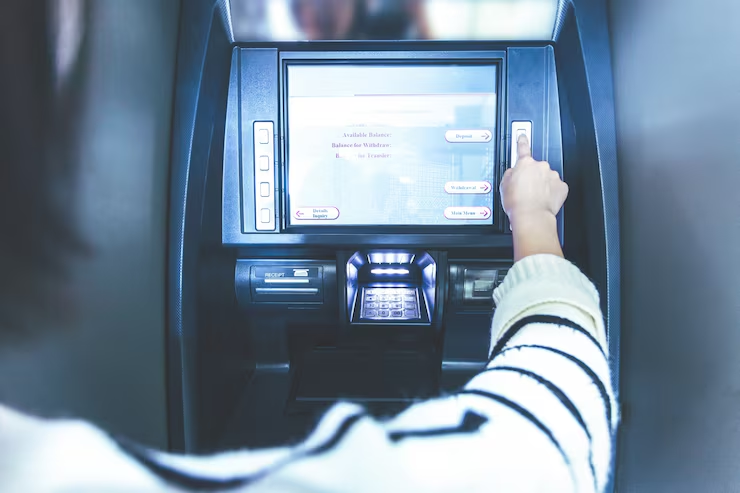
Kiosks are the most visible cash route in Florida and the one most people use. They work, they are legal, and they are expensive — 11% to 22% all-in depending on the corridor.
The cost is two numbers, and only one is displayed: a stated percentage fee of 8% to 14%, plus an exchange-rate markup of 3% to 10% buried inside the quoted price. Before you confirm any kiosk transaction, open the live bitcoin price on your phone and compare it to the machine's quote. That comparison is the only way to see half your cost.
Two 2026 developments matter. Bitcoin Depot, for years the largest US operator, filed Chapter 11 on 18 May 2026 and shut roughly 9,700 machines nationally — about 156 in Florida. Its branding is still on convenience-store walls statewide, and those machines are dead. And customers who had left balances in operator-controlled wallets became creditors in a bankruptcy, while customers who had withdrawn to their own wallets lost nothing.
Operators still running Florida networks include CoinFlip (roughly 270 machines, the largest surviving network), Byte Federal (headquartered in Venice, Florida, 110-plus Florida sites), Athena Bitcoin (Miami headquarters), Coinme via Coinstar, and RockItCoin. Full operator-by-operator detail, including fees, limits and corridor pricing across the state, is in our Florida kiosk guide.
If you are using a kiosk, do these six things
- Set up your own wallet before you leave home. Never let a machine create one for you.
- Confirm the machine is live on the operator's own locator, not a third-party map.
- Pick a corridor with multiple competing operators — that alone is worth three or four points.
- Compare the quoted rate to the live spot price before confirming.
- Keep the receipt. From 2027 it must show the transaction hash, wallet addresses, all fees and the refund policy.
- Verify the destination address on your own screen. Never scan a QR code someone else gave you.
Supermarket vouchers
Coinme, operating inside Coinstar machines in Florida grocery stores, has the widest raw location count in the state. It is important to understand that this is not an ATM — it is a voucher product. You insert cash, the machine prints a code, and you redeem the code inside the Coinme app to receive bitcoin.
Coinme's own documentation describes a 4% transaction fee plus a spread, with an all-in cash exchange fee in the region of 15% to 18% depending on location. You need a Coinme account and identity verification to redeem, so the "no ID" advantage does not survive contact with the product.
Where vouchers make sense: gifting a small amount of bitcoin to someone who does not have an exchange account, or buying a genuinely tiny amount out of curiosity. Where they do not: any kind of accumulation. Other voucher products — including Azteco, which sells bitcoin vouchers redeemable in any wallet without an account, and Bitnovo — have different trade-offs. See our crypto voucher hub for the full comparison.
Cash OTC desks
For large cash amounts — realistically $25,000 and up — an over-the-counter desk is the correct tool. Florida has real ones, concentrated in Miami: Athena Bitcoin runs its ACE desk from 1 SE 3rd Avenue in downtown Miami, and there are private-client desks in Brickell and one operating out of The Falls in South Dade.
A desk quotes you a single price for the whole block, which for large amounts is cheaper than walking up an exchange order book and paying invisible slippage. Expect 0.2% to 1% negotiated, versus 11% to 22% for the equivalent kiosk journey.
Two realities to plan for. Desks require full identity verification and, for cash, source-of-funds documentation — they are regulated businesses with anti-money-laundering obligations and they will ask where the money came from. And cash handling capacity varies: many desks prefer wire settlement and will handle only limited physical cash. Verify any desk's licensing before you walk in with money. Our Florida OTC guide covers how to approach one and what to ask.
Peer-to-peer, and why we do not recommend it
Peer-to-peer platforms and local meetups let you hand cash to an individual in exchange for bitcoin. The fees can be low. We still advise against it, for reasons that have nothing to do with pricing.
A cash-for-crypto meetup combines three things: an irreversible payment, a stranger, and the stranger knowing in advance that you will be carrying a specific amount of cash to a specific place at a specific time. There have been robberies, assaults and homicides across the United States arising from exactly this arrangement. No fee saving justifies it.
There is a second, quieter risk. If the crypto you receive was obtained through fraud or theft, it may be traceable and it may be frozen when it reaches a licensed exchange. You would then be the person holding the proceeds of someone else's crime, having paid real cash for it, with no counterparty to pursue.
And a third: accepting cash from strangers and forwarding crypto — or the reverse — for a fee is money transmission, which in Florida requires a licence under Chapter 560. People doing this informally at volume have been prosecuted. If someone offers to pay you to move money for them, that is not a side hustle, it is a criminal exposure.
If you are genuinely unbanked
A meaningful number of Floridians have no bank account — concentrated in Hialeah, parts of Miami-Dade, the Westside of Jacksonville, south St. Petersburg, Miami Gardens and the agricultural interior. If that is your situation, the ranking above is not condescension; it is the map to the exit.
Credit unions are the answer more often than people expect. Several Florida credit unions open a basic share account with a low or nominal minimum balance and no credit check. You typically need a government photo ID, a Social Security number or ITIN, and proof of address. Immigration status is not a bar to opening an account at many institutions, and an ITIN works where an SSN is unavailable.
That single hour of paperwork converts you from a 16% customer into a 0.2% customer permanently. On $200 a month it is worth about $370 a year, every year, forever.
If it is genuinely not possible, use kiosks strategically rather than habitually: competitive corridor, small amounts, rate checked against spot, and always to a wallet whose recovery phrase you hold. And be aware that stablecoin remittances — a common reason for cash purchases in Florida — only save money if the on-ramp is cheap. Buying USDT at a 17% kiosk and then sending it costs more than the wire service you were trying to avoid. See our Hialeah, Kissimmee and North Miami guides for the arithmetic.
Physical and financial safety
Cash transactions carry risks that bank transfers do not, and two of them are physical.
Carrying cash
Withdrawing several thousand dollars and driving to a machine in an unfamiliar area — often at the instruction of a stranger on the phone — is a personal safety problem before it is a financial one. If you must use cash, do it in daylight, in a busy location, in a neighbourhood you know, and tell someone where you are going.
The scam that uses cash specifically
Florida's dominant crypto fraud requires cash precisely because cash plus a kiosk equals an irreversible transfer. The sequence: a spoofed call claiming authority, manufactured urgency, an instruction not to tell anyone, a specific cash withdrawal, and driving directions to a named machine while the caller stays on the line.
FBI Internet Crime Complaint Center data cited in Florida's 2026 legislative record recorded 1,213 kiosk complaints in Florida during 2025 with $32.8 million in adjusted losses. Two facts stop nearly all of it. No bank, agency, utility, court or law enforcement body accepts payment at a crypto kiosk. And nobody genuinely on your side needs you to stay on the phone while you pay.
From 1 January 2027, Florida's Virtual Currency Kiosk Act requires pre-transaction fraud warnings, detailed receipts, daily caps of $2,000 and $10,000, and a full refund within 72 hours for a first-transaction fraud victim who reports to the operator and law enforcement within 60 days with documentation. Report incidents to FBI IC3 and the Florida Attorney General, and read our full scam guide.
Storing what you buy
Whatever route you use, send the crypto to a wallet whose recovery phrase you wrote down yourself, and — because this is Florida — put that phrase on a steel plate in a waterproof container inside your hurricane evacuation kit. Paper in a drawer in a surge zone is not a backup. See our wallet guide.
Related guides
Florida kiosk guide
Every operator, corridor pricing and the 2027 rules.
Read →Crypto vouchers
Coinme, Azteco, Bitnovo compared honestly.
Read →OTC desks
For cash amounts above $25,000.
Read →ACH & bank transfer
The cheapest funding route, explained.
Read →Selling for cash
Going the other way, and what it costs.
Read →49 city guides
Local cash corridors, city by city.
Browse →