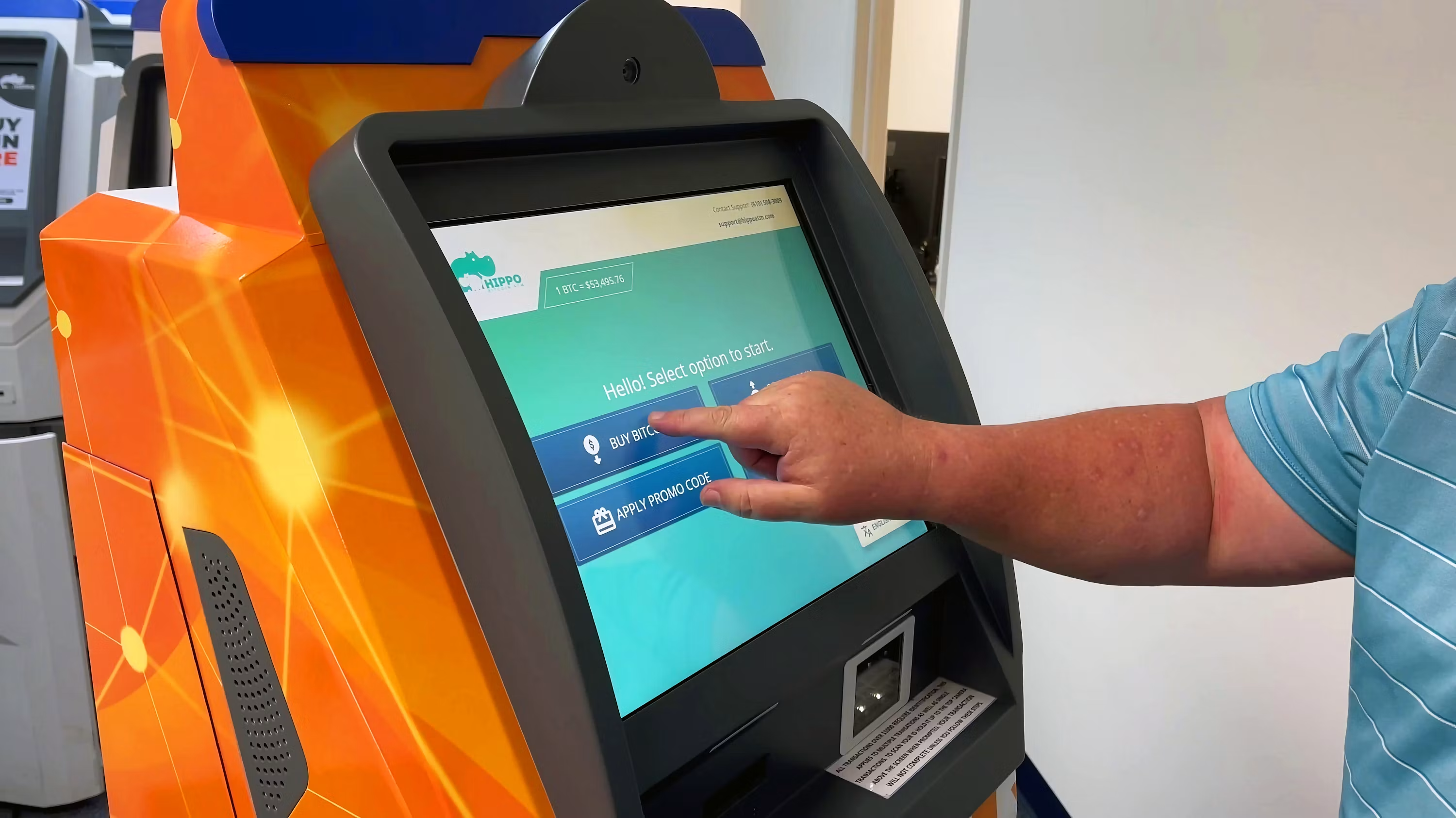
What a Florida kiosk really charges
Every conversation about Bitcoin ATM fees goes wrong in the same place: people quote the number on the screen. That number is roughly half the cost.
A Florida kiosk earns money in two layers.
- The stated fee. A percentage displayed before you confirm, typically 8% to 14% in Florida. Operators compete on this number because it is the visible one.
- The exchange-rate markup. The machine quotes you a bitcoin price that is worse than the real market price — commonly 3% to 10% worse. This is not disclosed as a fee anywhere, and it is why two machines advertising identical percentages can cost you meaningfully different amounts.
Add them and you get the real number: 11% to 22% all-in across Florida, depending on the corridor. On a $500 purchase that is $55 to $110. On $1,000 it is $110 to $220. The same purchase on a licensed exchange order book costs about $2 to $6.
| Route | Stated fee | Rate markup | All-in cost |
|---|---|---|---|
| Licensed exchange, order book | 0.16–0.40% | None | $2–$6 |
| Licensed exchange, instant buy | 1–1.49% | 0.5–1% | $15–$25 |
| Kiosk, competitive corridor | 8–10% | 3–6% | $110–$160 |
| Kiosk, cash-heavy neighbourhood | 10–14% | 5–8% | $150–$190 |
| Kiosk, tourist strip or island | 10–14% | 7–10% | $170–$220 |
| Coinstar voucher (Coinme) | 4% + spread | Included in 15–18% all-in | $150–$180 |
Our own modelling from published operator schedules plus observed exchange-rate markups. Individual machines vary; always read the on-screen quote before confirming.
Compare the machine's price to the real price
Before you confirm, open any price site or your exchange app and look at the current bitcoin price. Then look at the rate the machine is quoting you. The gap between them is the markup, and it is the half of the fee nobody tells you about. If the machine is quoting 6% below spot and charging a 10% fee, you are paying 16%.
The Bitcoin Depot collapse, and why it still matters
On 18 May 2026, Bitcoin Depot Inc. and sixteen affiliates filed voluntary Chapter 11 petitions in the US Bankruptcy Court for the Southern District of Texas, Houston Division. The company — for years the largest crypto ATM operator in North America, with more than 9,000 machines — announced it would wind down operations, sell its assets and establish a liquidation trust. Its entire network went offline.
Florida lost roughly 156 machines overnight, concentrated in convenience stores across Miami-Dade, Broward, Tampa Bay and Central Florida.
The reported causes were cumulative: a 49.2% year-on-year revenue decline in the first quarter of 2026 with a $9.5 million net loss against $12.2 million of net income a year earlier; Connecticut suspending its money transmission licence in March 2026; a breach in which attackers took $3.7 million from company crypto wallets; and litigation led by attorneys general in Massachusetts and Iowa alleging the company facilitated crypto scams.
The stickers are still on the walls
Convenience stores across Florida still display Bitcoin Depot branding. Those machines are dead. Do not insert cash to find out. More generally: check the operator's own locator rather than a third-party aggregator before you drive anywhere, because aggregator data lags reality by weeks.
There is a second lesson, and it is more important than the first. Customers who had left balances in wallets the operator controlled became unsecured creditors in a bankruptcy. Customers who had sent their crypto to a wallet whose recovery phrase they held themselves lost nothing. If a machine offers to "create a wallet for you", decline — set up your own wallet first. See our wallet guide.
Every operator still running in Florida
Six operators account for most of what remains. Two of them are headquartered in Florida, which is worth knowing.
CoinFlip
HQ: Chicago, ILAlso runs an OTC desk for larger tickets and a phone-based buying service.
Operator site ↗Byte Federal
HQ: Venice, FloridaThe only large operator actually headquartered in Florida. Disclosed a GitLab-related breach in December 2024 affecting about 58,000 customers — worth factoring into how much ID you hand over.
Operator site ↗Athena Bitcoin
HQ: Miami, Florida (1 SE 3rd Ave)Runs its own OTC desk, ACE, out of downtown Miami for private clients and trade customers.
Operator site ↗Coinme (at Coinstar)
HQ: Seattle, WAYou buy a paper voucher at the kiosk and redeem it in the Coinme app — this is a voucher product, not a true two-way ATM.
Operator site ↗RockItCoin
HQ: Chicago, ILLive phone support during purchases is genuinely useful for first-time kiosk users.
Operator site ↗Bitcoin Depot
HQ: Atlanta, GABitcoin Depot and 16 affiliates filed Chapter 11 in the Southern District of Texas on 18 May 2026 and pulled their entire ~9,700-machine network offline. If a sticker on a convenience-store machine still says Bitcoin Depot, that machine is dead — do not insert cash.
Operator site ↗Also present in smaller numbers: Coinhub, Cryptobase, GetCoins, BudgetCoinz and Pay Depot. Their pricing sits inside the same 11% to 22% band and the same advice applies.
Byte Federal operates from Venice, Florida, on the Gulf coast in Sarasota County — the only large national operator actually based in the state. Athena Bitcoin Global runs its operation from 1 SE 3rd Avenue, Suite 2740, in downtown Miami, with machines across 29 states and five Latin American countries plus its own OTC desk. If you want to know why Florida has so many kiosks, part of the answer is that the industry lives here.
Cheapest and most expensive corridors in Florida
Kiosk pricing is a function of local competition, not local cost. The same machine model charges 11% on one road and 20% on another twenty minutes away, because one faces four competitors and the other faces none. Once you understand that, the map makes sense.
Cheapest corridors we have modelled
- Federal Highway (US-1), Broward County — Fort Lauderdale through Pompano and Deerfield. Multiple operators over many miles.
- Cleveland Avenue (US-41), Fort Myers — the densest competitive stretch in South-West Florida.
- Dale Mabry Highway, Tampa — long commercial run, several operators, ~11–15%.
- 34th Street (US-19), St. Petersburg — genuine price competition.
- Military Trail & Congress Avenue, West Palm Beach — surprisingly keen for Palm Beach County.
- Nine Mile Road, Pensacola — best pricing in the Panhandle.
Most expensive
- Washington Avenue & Collins, Miami Beach — the highest pricing we have found in Florida, 18–22%.
- Duval Street, Key West — island isolation, no competition within an hour.
- Panama City Beach in season — spring-break markups widen sharply.
- International Drive, Orlando — tourist corridor pricing near 20%.
- Sawgrass Mills area, Sunrise — enormous footfall, no price memory.
- Clearwater Beach — roughly six points above the same operator six miles inland.
Our 49 city guides break this down corridor by corridor, including which neighbourhoods in each city have the highest density and why. The pattern repeats statewide: machines cluster where cash usage is highest and banking access is thinnest, and they price against check-cashing and money-transfer services rather than against exchanges.
How to use a Florida kiosk without being fleeced
Kiosks have a legitimate use: you have physical cash, you have no bank account or no time, and you want crypto now. If that is genuinely your situation, here is how to minimise the damage.
- Set up your own wallet first. Before you leave the house. Write the recovery phrase on paper, then transfer it to steel later. Never let a machine create a wallet for you.
- Confirm the machine is live on the operator's own locator, not a third-party map. Aggregators are weeks behind reality, especially after the Bitcoin Depot shutdown.
- Choose a competitive corridor. If two machines from different operators are within a mile, check both. Three or four percentage points is common.
- Read both numbers before confirming. The on-screen fee, and the quoted rate against the live spot price on your phone.
- Keep the receipt. From 1 January 2027 it must show the transaction hash, source and destination wallet addresses, all fees and the refund policy. That is your evidence if anything goes wrong.
- Verify the destination address on your own screen — not from a QR code someone else sent you. This single step defeats the entire kiosk scam.
Never, under any circumstances
- Use a kiosk while someone is on the phone with you. That is a scam in progress, without exception.
- Scan a QR code or wallet address that another person supplied.
- Pay a bill, fine, tax, fee, bail or "verification" at a crypto kiosk. No legitimate organisation on earth accepts this.
- Insert cash into a machine whose screen will not connect.
- Leave crypto in a wallet whose recovery phrase you do not hold.
Limits, ID requirements and the 2027 caps
Today, limits and identity requirements vary by operator and verification tier. Small purchases have historically been possible with only a phone number; larger tiers require a government ID, a selfie, and sometimes a proof of address.
From 1 January 2027, Florida's Virtual Currency Kiosk Act imposes statutory caps that apply to every operator in the state:
The caps are aggregated across transactions and across machines, which is why the law also requires operators to ask, before each transaction, whether you have used another kiosk that day. That question exists to catch people mid-scam, and it will catch some.
Operators must also register with the Florida Office of Financial Regulation before operating, with existing operators given 30 days after 1 January 2027 to apply and registration required from 1 March 2027. Licensed money transmitters are exempt from separate kiosk registration but must still follow the conduct rules. Full detail on our Kiosk Act explainer.
The privacy cost nobody mentions
Kiosks are often described as the private way to buy crypto. For verified transactions, that is backwards.
When you complete an ID-verified kiosk purchase, the operator collects and retains your name, address, phone number, a photograph of your government ID, a photograph of your face, and your complete transaction history — held by a company whose security posture you cannot audit and whose corporate stability, as 2026 demonstrated, is not guaranteed.
That is not hypothetical. In December 2024, Byte Federal — the Venice, Florida-headquartered operator — disclosed a data breach affecting approximately 58,000 customers, caused by exploitation of a vulnerability in the third-party GitLab platform. Reported exposed data included names, addresses, phone numbers, government-issued IDs, Social Security numbers, transaction activity and user photographs. The company stated it shut down its platform, isolated the intruder and had no evidence of actual misuse; class-action litigation followed and a settlement was later agreed.
We raise this not to single out one operator — breaches occur across financial services — but because it is a real cost that never appears on a fee screen. A licensed exchange holds similar data, so this is not an argument that exchanges are risk-free. It is an argument for minimising the number of separate companies holding your identity documents, and for scepticism about any machine demanding more verification than the transaction warrants.
The kiosk scam, step by step
Florida kiosks are the single most common conduit for a specific fraud, and FBI Internet Crime Complaint Center data cited in the state's 2026 legislative record recorded 1,213 kiosk complaints in Florida during 2025 with $32.8 million in adjusted losses. Recognising the shape is the entire defence.
- Spoofed authority A caller claims to be from your bank's fraud department, Medicare, the Social Security Administration, a utility about to disconnect, Amazon about a fraudulent order, a court about a missed jury summons, or a sheriff's deputy with a warrant. The caller ID looks real because it is faked.
- Urgency plus secrecy Something terrible happens within hours. And — this is the tell — you must not tell anyone. The investigation is confidential. Bank staff cannot be trusted. Your family will worry.
- A specific withdrawal You are told exactly how much to withdraw, and coached on what to say if a teller asks questions.
- Directions and a QR code You are given the location of a named kiosk, often twenty or thirty miles away. The caller stays on the line while you deposit the cash and scan a QR code they supply. That code is their wallet address.
- Irreversible Once the transaction confirms on the blockchain it cannot be recalled, unlike a card payment or even a bank wire.
Two facts stop nearly all of it. No bank, government agency, utility, court or law enforcement body accepts payment at a cryptocurrency kiosk — ever, anywhere, for any reason. And nobody who is genuinely on your side needs you to stay on the phone while you pay.
If it has already happened: report immediately to FBI IC3 and the Florida Attorney General, and notify the kiosk operator in writing. The Attorney General's Cyber Fraud Enforcement Unit recovered $5.4 million in a single case announced in April 2026 and has reported $7.2 million recovered in total. From 1 January 2027, a first-transaction victim who reports to the operator and law enforcement within 60 days with documentation is entitled to a full refund within 72 hours. Read our full Florida scam guide.
Related guides
Buying with cash
Every cash route in Florida, ranked by real cost.
Read →The 2027 Kiosk Act
HB 505 in full: caps, receipts, refunds, registration.
Read →Crypto vouchers
Coinme, Azteco, Bitnovo — how vouchers differ from ATMs.
Read →Miami kiosks
Neighbourhood-by-neighbourhood fees in Miami.
Read →Tampa kiosks
Corridor breakdown across Hillsborough County.
Read →Florida scam guide
The frauds targeting Floridians, and how to stop them.
Read →